
Hydration influences endurance performance, recovery, and heat tolerance.
Yet most athletes still do not know how much fluid or sodium they actually lose when they sweat.
Instead, hydration strategies are often based on averages, estimates, or calculators that cannot account for individual differences or changing conditions.
To move personalised hydration forward, sweat data needs to be measured accurately and validated against established scientific reference methods. That is why FLOWBIO pursued independent academic validation of its wearable sweat sensor.
What is the FLOWBIO sweat sensor?
The FLOWBIO Sensor is a reusable, non-patch sweat sensor designed to measure whole body sweat loss and track sweat sodium during exercise. It can be worn on the upper arm using the FLOWBIO arm strap, or integrated with existing arm-based heart rate straps and compatible chest strap systems. The sensor analyses sweat as athletes train, rather than relying on post-session estimates or generic calculators.

Why validating a sweat sensor matters
Sweat rate and sodium loss vary widely between individuals and conditions. and can change significantly with:
-
Exercise intensity
-
Temperature and humidity
-
Session duration
-
Individual physiology
Generic hydration advice and online calculators cannot account for this variability. Without accurate measurement, athletes risk under drinking, over drinking, or replacing fluid without enough sodium. Independent validation helps confirm whether a wearable sweat sensor can provide data that is meaningful outside the laboratory and useful in real training environments.

Who conducted the validation study
The research was led by David Bandiera under the guidance of Yannis Pitsiladis and Sebastien Racinais and Antonio Tessitore, with an international team of sport science researchers including Jean de Bardonnèche, Delphine Margout-Jantac, Léa Dubois, Nisrine El Allaoui, Jonathan Steven Elie Rubio, Jean-Christophe Aubin.
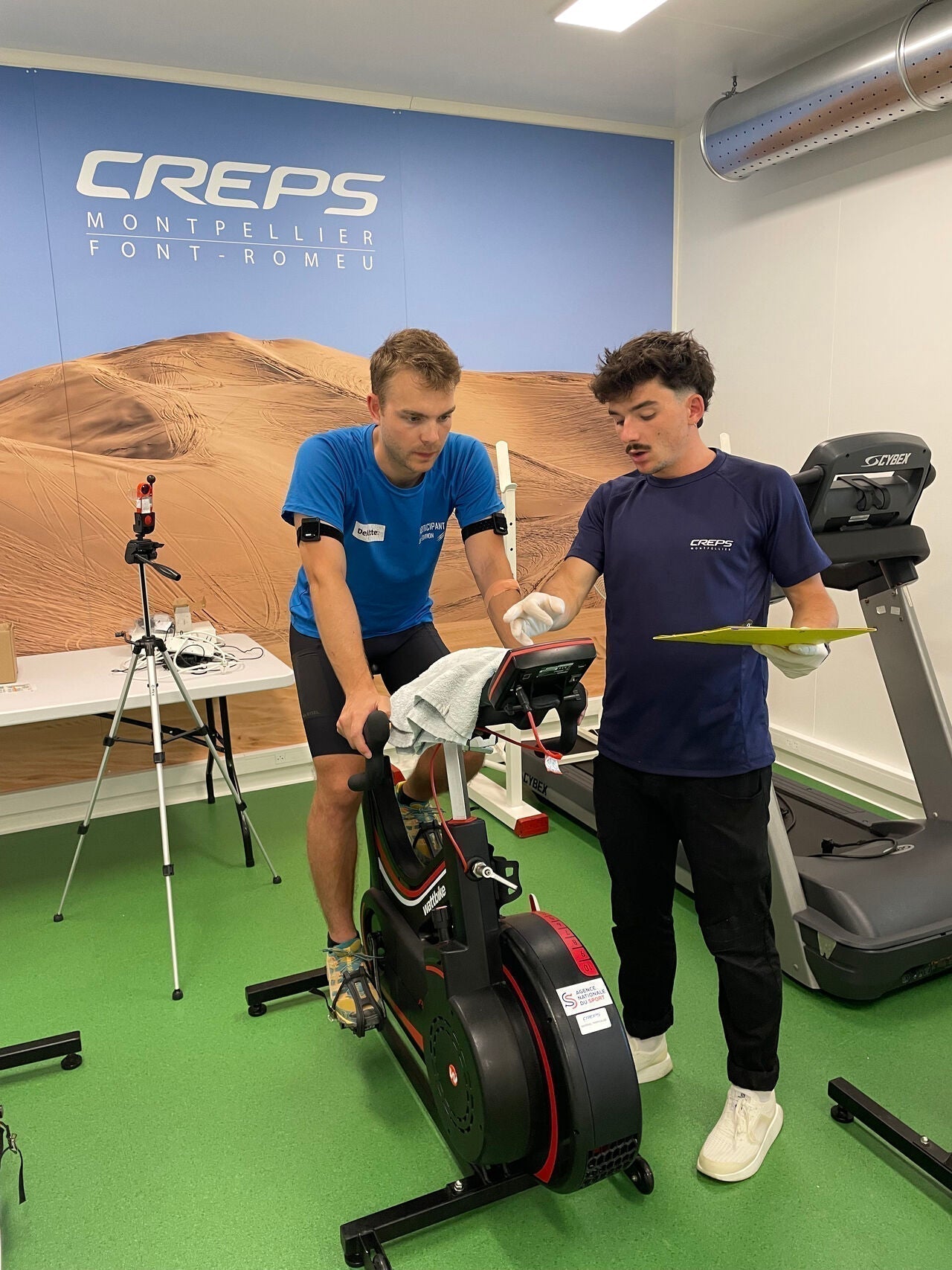
The study was conducted through the University of Rome Foro Italico and the CREPS Montpellier, with support from Human Telemetrics.
The study underwent full peer review and was published in Frontiers in Physiology.

How the FLOWBIO sweat sensor was tested
Twenty three recreationally active endurance-trained adults completed indoor cycling sessions lasting approximately 75 minutes.
Exercise was performed at a demanding but sustainable intensity in both hot and dry and hot and humid laboratory conditions. Participants wore the FLOWBIO Sensor on the upper arm throughout each session.
Reference methods used
Sweat and hydration were assessed using:
-
The FLOWBIO sweat sensor
-
Laboratory flame photometry, the gold standard for sweat sodium measurement
-
Pre- and post-exercise body mass change, the gold standard method for measuring whole body sweat loss
-
The LAQUAtwin Na-11 portable analyser, a commonly used field-based sweat sodium testing tool
This design allowed direct comparison between wearable, laboratory, and established field-based methods.
What the study found about sweat loss:
-
Average whole body sweat loss during the sessions was approximately 1.3 litres.
-
Sweat loss estimated by the FLOWBIO Sensor showed no significant difference compared with values calculated using body mass change. Wearable estimates closely matched the laboratory reference method.
By comparison, an online sweat rate calculator significantly underestimated sweat loss under these hot conditions.

What the study found about sodium loss
Sweat sodium concentration varied widely between athletes, reinforcing how individual hydration needs are.
The FLOWBIO Sensor produced sweat sodium values comparable to those obtained using the LAQUAtwin Na-11 portable analyser, a field standard commonly used in endurance sport. Both the wearable sensor and the LAQUAtwin Na-11 measured slightly lower sodium values than laboratory flame photometry, but they were consistent with each other.
Unlike the LAQUAtwin Na-11, which requires sweat sample collection and post-session analysis, the FLOWBIO Sensor does not require sweat patches or manual sampling and can be used repeatedly to track sweat sodium during training, making it more practical for regular use.

What this means for endurance athletes
The FLOWBIO Sensor displayed its first stable sweat sodium readings approximately eight minutes after exercise began, once sweating was established.
Participants reported very low levels of discomfort while wearing the sensor, indicating it did not meaningfully interfere with exercise. Secure sensor placement was identified as important for optimal measurement.
Sweat loss and sodium loss change with:
-
Exercise intensity
-
Heat and humidity
-
Session duration
-
Individual physiology
Relying on averages or calculators can lead to hydration strategies that do not match an athlete’s real needs. Measuring sweat during training allows athletes to make more informed decisions about what to drink, how much to drink, and when.

View the full peer-reviewed study in Frontiers in Physiology
Read the complete validation paper published in Frontiers in Physiology, including full methodology, results, and analysis.
→ View the study on Frontiers here
Share:
Why Winter Training Quietly Increases Dehydration Risk
How Accurate Are Sweat Sensors? A Science Led Guide to Sweat, Hydration, and Electrolytes