
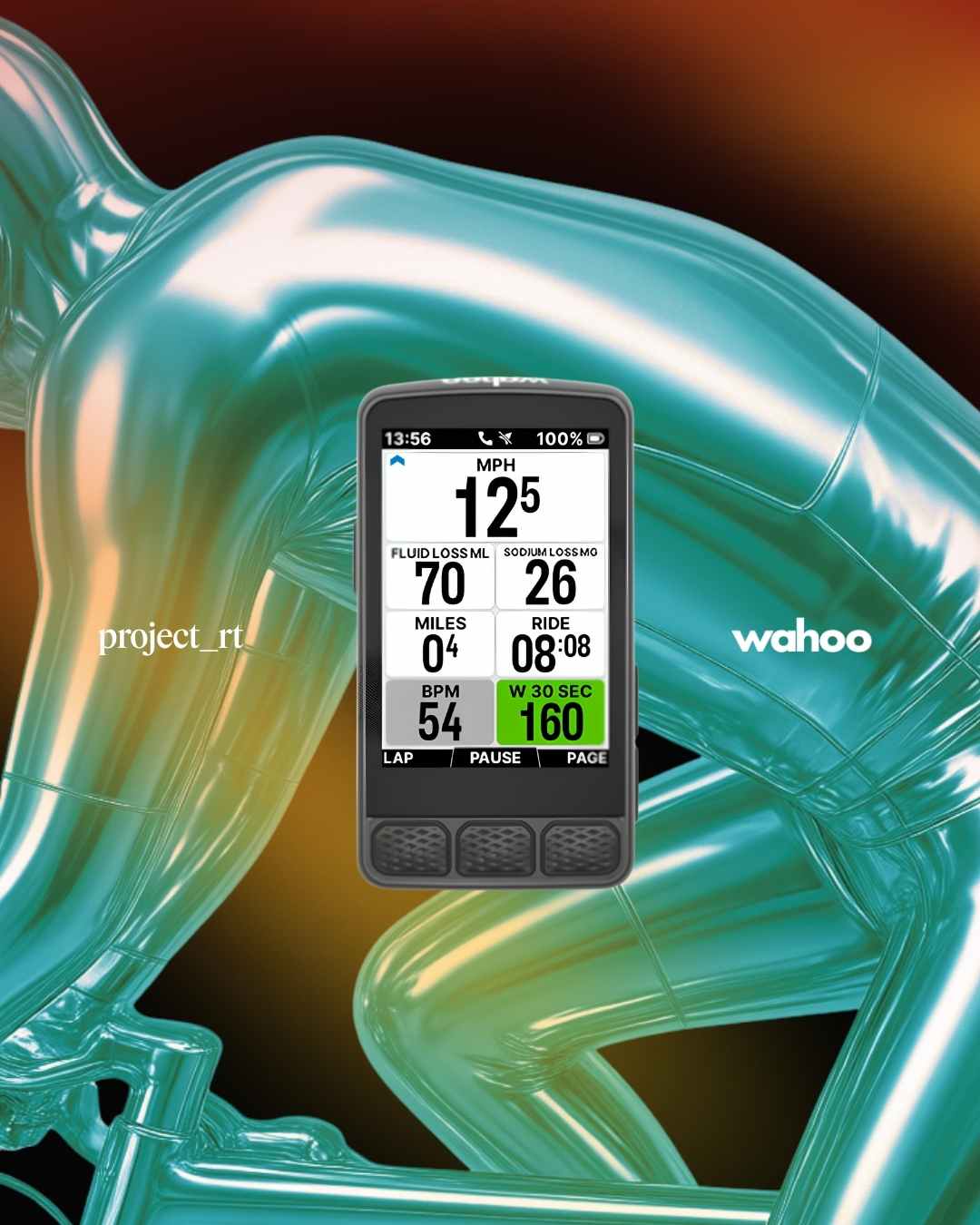
Real-time sweat data comes to Wahoo: the newest piece of the FLOWBIO system
We are bringing real-time sweat data to the Wahoo ELEMNT ACE, BOLT 3 and ROAM. From today (16.06.26), cyclists wearing a FLOWBIO Sensor can see their live fluid and sodium loss on the head unit, in the same data view as power, heart rate and cadence, and act on it while they ride.
This is not a new device. It is a new capability for athletes already using FLOWBIO, and the moment sweat science moves out of post-session analysis and into the session itself. We are releasing it as an early-access BETA.
It is also worth stepping back to see the whole picture, because real-time is one phase of something larger. Every serious endurance athlete trains on data, yet hydration has been the last variable left to estimation while power, pace and heart rate are measured and acted on in the moment. FLOWBIO closes that gap across the entire session, not at a single point, with a hydration system that runs before, during and after every effort from one continuous source of measurement. Here is how that system works, and where the new Wahoo integration fits.
The foundation: continuous, validated measurement
At the centre of the system is the FLOWBIO Sensor, which measures fluid and sodium loss continuously while you exercise. It can be worn optically on the arm or clipped onto a standard heart rate chest strap, so it fits within the kit you already use. Every reading feeds our Advanced Hydration Intelligence (AHi) platform, which turns raw physiology into a plan you can act on.
Why individual measurement matters
Athletes track pace, power and heart rate with precision, but hydration remains a guess. 2% dehydration can reduce performance by up to 10%, yet most guidance still relies on single-use lab tests that fail to account for individual physiology. Sweat rate and sodium loss are not fixed. They shift with temperature, intensity and heat acclimation. What works in the lab rarely holds up in real conditions.
As Jeukendrup and Maughan have noted, strategies built on an individual sweat profile produce meaningfully different outcomes than one-size-fits-all guidance, and sex differences (Yanovich, Ketko and Charkoudian, 2020) and heat acclimation (Périard, Eijsvogels and Daanen, 2021) shift hydration needs further. Two athletes completing the same ride in the same conditions can finish with substantially different deficits. Without measurement, neither knows which they are in until they feel it.
Three phases, one system
The system draws on that same continuous measurement at every stage of training, and each phase connects to the next.
Phase 1, pre-session: the Hydration Planner. Before you start, the Hydration Planner builds a session-specific strategy. It combines your historical sweat data, your individual sweat rate and sodium concentration built up over previous sessions, with the planned intensity (in power and heart rate targets) and the forecast conditions, primarily temperature. The output is a personalised plan of volumes and timing, not a generic target. You arrive with a strategy that reflects your physiology and the day, not a chart designed for someone else.
Phase 2, in-session: live data, now on your Wahoo ELEMNT. During the session, the sensor streams live fluid and sodium loss to the head unit, in the same data view as power, heart rate and cadence. You can see whether your intake is keeping pace with your losses and adjust in real time, rather than discovering the deficit afterwards. If it is hotter than forecast or the intensity runs higher than planned, the live data reflects it and you respond. This in-session capability is the newest part of the system. We are releasing the Wahoo ELEMNT integration as an early-access BETA: the sensor science is validated and published, the integration itself is new, and the riders who use it first are among the first anywhere to train with live sweat data on their head unit.
Phase 3, reovery: the Recovery Plan. After the session, AHi calculates your true residual deficit. It draws on the session's continuous sweat data and cross-references it with what you actually consumed, not an assumed figure, prompting you to log fluid and sodium intake during the session, including a zero if nothing was taken on. The Recovery Plan then outputs a personalised rehydration window, with fluid replacement shown in blue and sodium replacement in yellow. Intake safety limits adjust the recommendation for session duration and absorption rates, and optional reminders can prompt intake through the window. The target is built to ACSM guidelines, which recommend replacing 150% of fluid losses in the hours after exercise to account for ongoing losses during recovery.
Proven at the highest level
The approach has been validated in the peer-reviewed literature and in applied practice across professional endurance sport. World Tour cycling teams have used the sensor for testing, T100 Triathlon World Tour athletes including Sam Dickinson and Ellie Salthouse train and race with FLOWBIO data, and performance centres including Red Bull in Salzburg use the system. Kevin Poulton at UAE Team Emirates is among the coaches who have built FLOWBIO into structured athlete programmes.
Availability and cost
The FLOWBIO Sensor is priced at £295.00 including VAT (£245.00 excluding VAT), with compatibility extending across Wahoo, Garmin, Coros and Zwift. The real-time integration is compatible with the Wahoo ELEMNT ACE, BOLT 3 and ROAM, in early-access BETA, and works with your existing sensor via a firmware update at no additional cost.
Get set up
Please check your inbox for your real-time invite. If you haven't recieved the email, please contact team@flowbio.com and we will assist.
Share:
Introducing the new FLOWBIO app and features
Training in the Heat: How to Hydrate, Perform and Recover Better